
The office phone booth has become a permanent fixture in contemporary workplaces with the widespread adoption of open-plan layouts. Its role responds to a now structural need: providing spaces for concentration and privacy within shared environments. In an increasingly hybrid working landscape, shaped by calls, video meetings, and cognitively demanding individual tasks, the phone booth has emerged as a strategic design tool for ensuring acoustic comfort and overall work quality.
According to data gathered by Leesman and Gensler, more than 60 per cent of employees working in open-plan offices report difficulties concentrating due to noise and frequent interruptions. Gensler’s Global Workplace Survey shows that environments offering dedicated spaces for focused work achieve significantly higher productivity levels than those without acoustic isolation areas. Office phone booths fit precisely into this scenario, addressing a common shortcoming of open-plan offices.
What an Office Phone Booth Is Used For
Conceived as a contemporary reinterpretation of the traditional public phone booth, the one for the office is a compact freestanding module, or part of a broader system, equipped with a door and designed to accommodate one person, and in some cases two. This sound-insulated enclosure is used whenever privacy and concentration are required: for focused work, phone calls with colleagues or clients, and virtual meetings.
From an organisational perspective, the presence of office phone booths reduces acoustic pressure within open-plan environments and supports the coexistence of different working modes. Recent studies indicate that the ability to choose where to carry out a specific task increases perceived control over the environment and has a positive impact on overall job satisfaction.
How an Office Phone Booth Is Designed

Available in a range of dimensions depending on the space available, a soundproof booth is composed of an external structure that can be customised in finishes and colours. Access is typically provided through a tempered glass door, which may be transparent or opaque depending on the desired level of privacy. For ease of use, an automatic door closer is often included, while handles are generally compact and made of stainless steel.
The interior walls are lined with sound-absorbing materials, with felt being among the most widely used for its acoustic performance. Flooring also plays a role in sound absorption, with materials such as carpet commonly selected to enhance overall acoustic comfort.
Work Surface, Technology, and Equipment
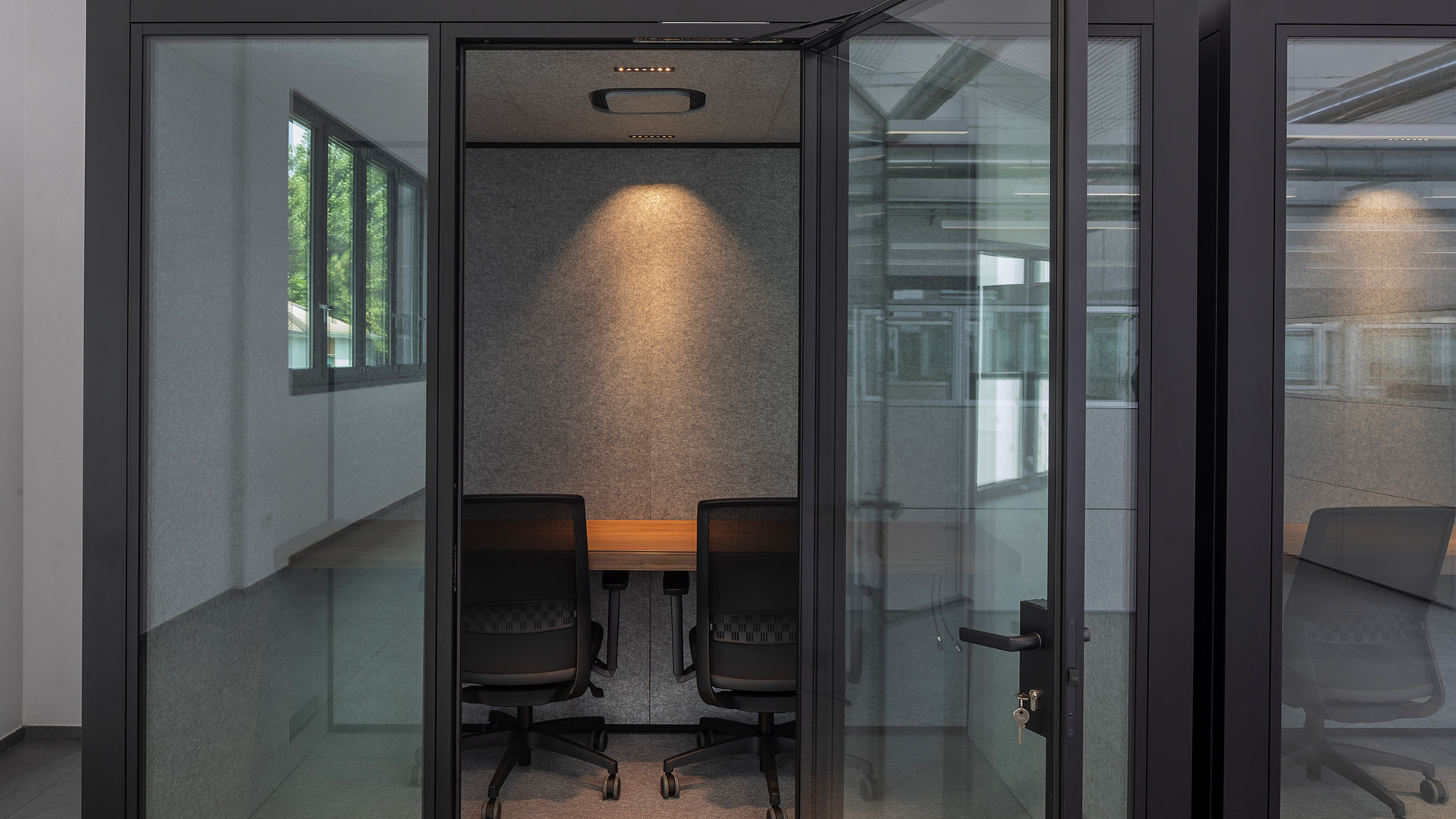
To support laptops, phones, notepads, and personal items, phone booths are fitted with a shelf that functions as a work surface. Power sockets are integrated into the top or directly into the booth structure, allowing for easy charging of smartphones and other electronic devices. In some cases, a screen can be installed above the shelf and mounted directly to the wall, facilitating video calls and virtual meetings.
Seating and Lighting in Phone Booths
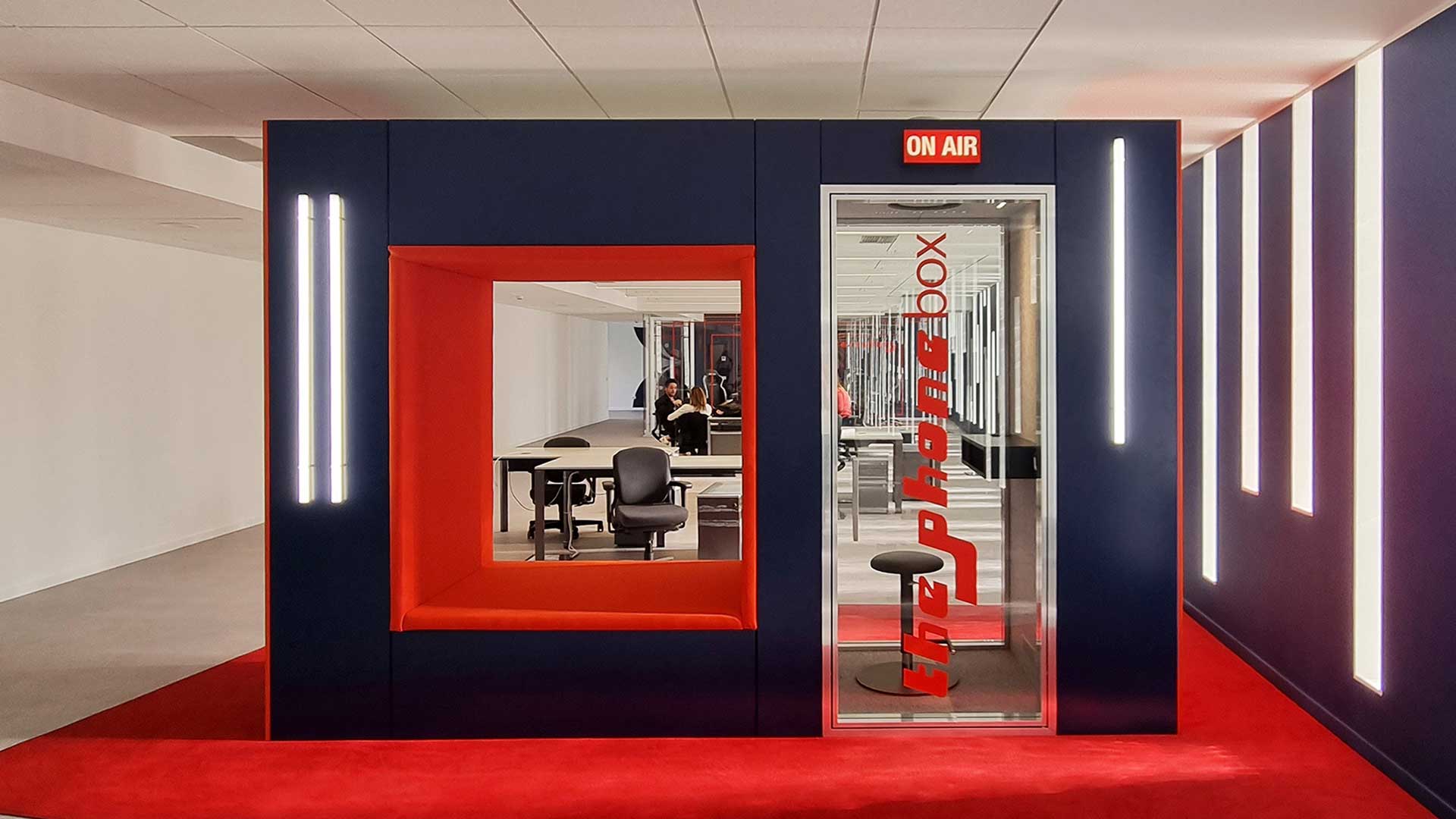
Seating is typically provided by a high stool, reflecting the fact that work surfaces are installed at a height suitable for use while standing as well. Furniture selection therefore becomes an integral part of the phone booth design: through form and colour accents, it can characterise the booth and visually distinguish it from other office areas.
Lighting is integrated through recessed spotlights or LED strips, with colour temperature carefully calibrated to reduce visual fatigue during calls. Ventilation represents a central design consideration: extractors and automatic air exchange systems ensure comfort and air quality, particularly when booths are used repeatedly throughout the day.
Design Guidelines for Integrating Phone Booths
To maximise effectiveness, phone booths should be positioned close to operational areas, while avoiding high-traffic corridors. A balanced ratio is typically around one booth for every six to eight workstations, although this may vary depending on the frequency of calls and virtual meetings.
From an acoustic standpoint, the performance of the booth should be evaluated alongside the treatment of the open-plan space as a whole. Sound-absorbing ceilings, panels, and furnishings contribute to a more effective overall result. When integrated into a coherent strategy, the office phone booth becomes a key element in improving productivity, wellbeing, and the quality of the workplace experience.
Office Phone Booths: A Solution for Contemporary Workplaces
The rise of open-plan layouts as the dominant office configuration has created environments that encourage information exchange among colleagues but, when not carefully designed, can lead to acoustic overload. Alongside the use of glazed partition systems to create enclosed spaces, office phone booths have emerged as a complementary solution: intuitive to use and effective in promoting privacy and acoustic wellbeing.
Level Office Landscape offers customised phone booth solutions tailored to the needs of contemporary offices. For a personalised quotation, simply complete the dedicated form or call +39 039 9284831